Composite membranes, optimized from second-generation PPS mesh, feature dense nano-channels produced via phase separation. Given their distinct characteristics in materials and manufacturing, establishing a comprehensive evaluation system is critical for optimizing electrolyzer performance. This article focuses on three core pillars: electrochemical performance, gas barrier properties, and physical/chemical stability.
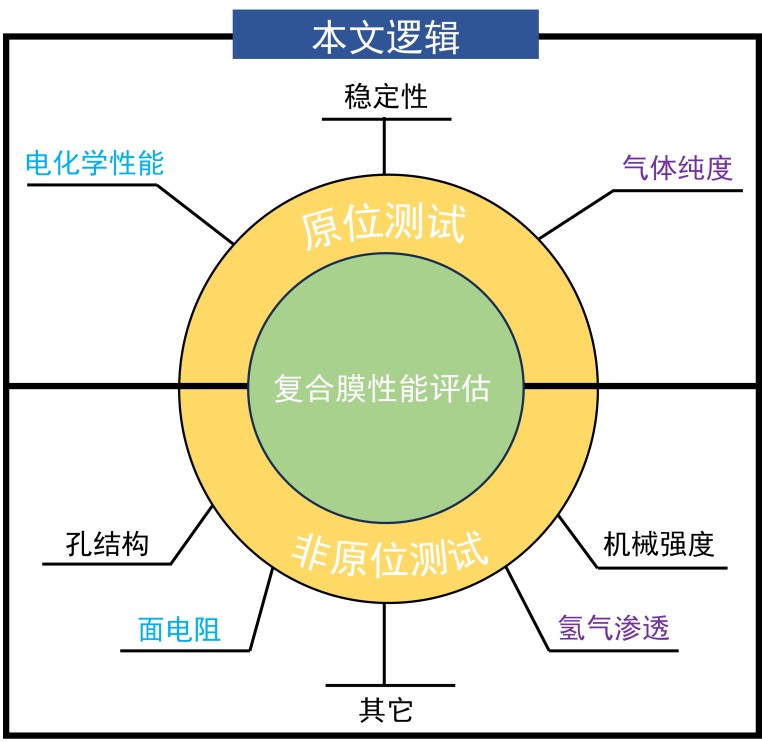
I. Ex-Situ Membrane Testing
Performance is fundamentally measured through pore characteristics:
Pore Size & Distribution: Analyzed via the Bubble Point and Mean Flow Method (GB/T 32361-2015).
Pore Structure: Categorized by cross-sectional SEM imaging (Fig 2):
Finger-like Pores (Fig 2a): Enhance mass transport but may reduce gas purity.
Sponge-like Pores (Fig 2b): Provide superior gas barrier properties and mechanical durability.
Porosity: Determined via the Hexadecane Absorption Method (GB/T 33052-2016).
Tortuosity: A crucial but complex parameter that currently relies on model-specific fitting rather than a universal standard.
Practical Case Study: Misconceptions in Areal Resistance
Clients often report high ex-situ resistance despite excellent in-cell performance due to:
Incomplete Wetting: The dense 500+μm structure requires extensive soaking time.
Electrode Distance: In-cell "zero-gap" conditions are more sensitive than ex-situ setups.
Experimental Errors: Variations in temperature, bubble presence, and electrode alignment.
Hydrogen Permeability
Evaluated via direct (H-cell) or indirect (HOR limiting current) methods. As these cannot fully replicate industrial dynamic environments, they should be used as secondary reference metrics.
II. In-Situ Membrane Testing
In-situ testing assesses membranes under operational conditions (current density, voltage, and gas purity). To ensure data integrity, it is vital to control variables strictly, isolating the membrane's impact from other electrolyzer components.
Summary: Ex-situ testing provides the screening baseline, while in-situ testing serves as the ultimate validation. A holistic approach is essential for accurate membrane evaluation.